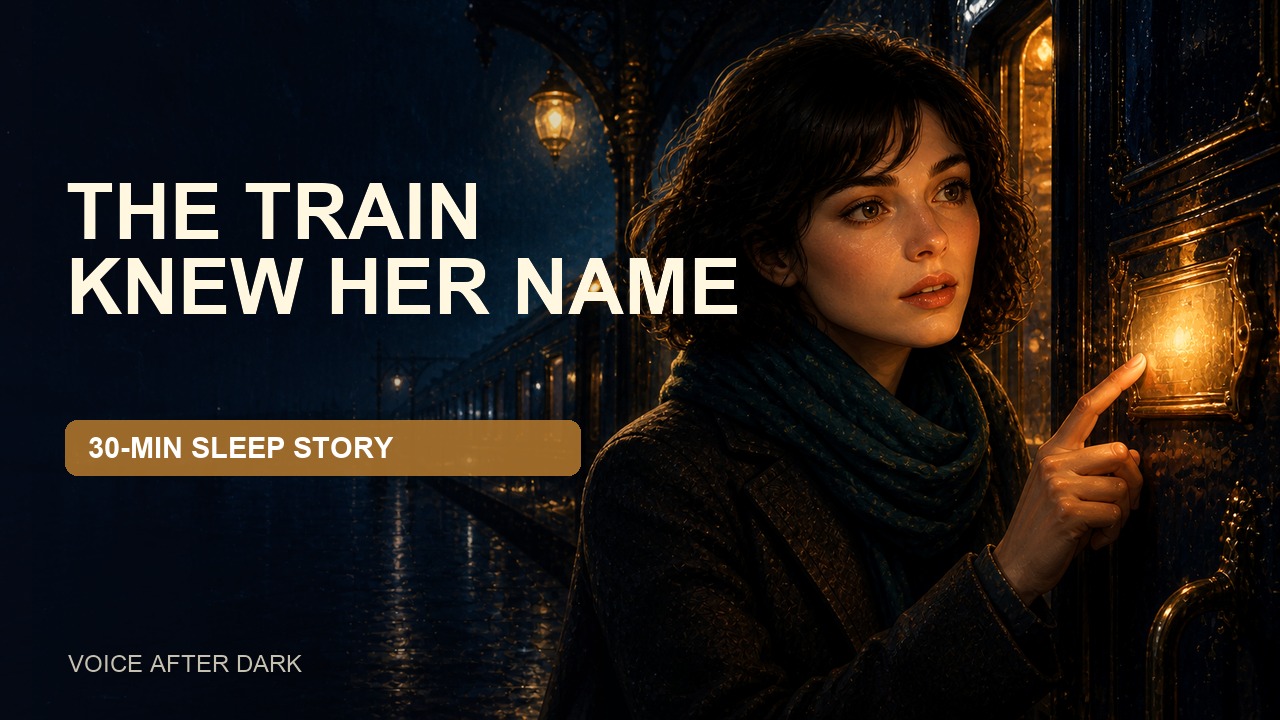
An original cozy-fantasy sleep story written for Voice After Dark.
c01 — The Train With Her Name
s01
At eleven fifty-seven, the clock above Platform Six stopped. The second hand shivered once between two silver marks, and then held perfectly still. At midnight, a train without a number slid out of the rain. It made no sound on the rails. No whistle, no brakes, not even the ordinary sigh of doors preparing to open. It was simply not there, and then it was: six dark-blue carriages, windows glowing amber, brass fittings polished bright enough to catch every drop of rain. Mara Finch stood beneath the station awning with a ring of office keys in one hand and an umbrella in the other. The last passenger train had left forty minutes ago. She knew because she had locked the lost-property room, checked every bench, and turned off every lamp except the one above the exit. Yet this train waited beside her as though it had been expected all evening. On the nearest brass door, where a route number should have been, someone had written two words in a careful hand: MARA FINCH.
s02
Mara had worked at Rookery Station for seven years, which was long enough to know that stations collected more than luggage. They collected unfinished sentences, courage that arrived one minute too late, and small decisions people promised to make after they reached somewhere else. Mara catalogued the solid things. A red mitten. A violin bow. Three novels, all abandoned before the final chapter. She was very good at returning what could be returned. Her desk held stacks of labelled envelopes, and her handwriting was so neat that travelers sometimes sent thank-you notes addressed only to The Woman Who Finds Things. But that night, in the bottom drawer, there was one object she had never entered in the ledger: a brass watch with a cracked white face. It had belonged to her grandmother. Mara had carried it to work every day for two years, intending to repair it when she had time. Time, however, had become the very thing she never seemed to have. The watch had stopped at eleven fifty-seven. So had the clock above Platform Six.
s03
The train door opened. Warm light spilled across the wet platform, and a narrow set of blue-carpeted steps unfolded at Mara's feet. On the top step lay a ticket the color of cream, edged in gold. It read: ROOKERY TO BELLWETHER. DEPARTURE, MIDNIGHT. RETURN, WHEN READY. Mara looked along the platform for a camera, a railway inspector, anyone prepared to explain the joke. Rain tapped the glass roof. Somewhere beyond the station, a taxi sounded its horn and drove away. Then a voice from inside the carriage said, gently, “You can stand in the rain and wonder for another minute, Miss Finch. But the train will still be real.” Mara should have locked the final door and gone home. She should have heated the soup waiting in her refrigerator and answered the messages she had been avoiding. Instead, she slipped the office keys into her coat pocket, picked up the impossible ticket, and stepped aboard. Behind her, Platform Six folded into the rain like a page being turned.
c02 — A Ticket for Bellwether
s04
The man waiting inside wore a midnight-blue conductor's coat with silver buttons. He looked a little older than Mara, though not by much, and had the calm expression of someone who had never once needed to run for a train. A small brass lantern hung from his hand. Its flame burned green at the center. “Rowan Vale,” he said, touching two fingers to the brim of his cap. “Conductor, porter, occasional maker of tea, and tonight, apparently, your welcoming committee.” Mara held up the ticket. “I didn't buy this.” “No one buys a ticket to Bellwether.” “Then who sent it?” Rowan glanced toward the windows, where the dark city was already moving away. “Usually, the passenger does. Just not the version of them who is standing on the platform.” He reached for the ticket, but did not take it. “You may leave at the next stop, if you wish. You may ride to the end. And when you are ready, the train can return you to the minute you left.” Mara looked back. There was only rain and the faint reflection of her own astonished face. “That sounds very convenient,” she said. Rowan smiled. “Magic often does, right before it becomes complicated.”
s05
The passenger carriage was more sitting room than railway car. Deep green chairs faced wide windows. Reading lamps glowed beneath little shades of amber glass. A knitted blanket waited over every armrest, each in a different color, as if the train had asked a town of grandmothers for help. There were shelves of books, but their spines were blank. There was a fireplace, though Mara could not see how a chimney might fit beneath the carriage roof. Most curious of all, the room smelled faintly of cedar, orange peel, and the dusty warmth of the workshop where her grandmother once repaired clocks. Mara touched the nearest table. The wood was warm. “Where are the other passengers?” she asked. Rowan set his lantern on a hook beside the door. “Elsewhere on the train. Everyone gets the journey they can hear.” “And what journey is this?” “Yours.” The answer should have made the carriage feel smaller. Instead, something in Mara's shoulders loosened. Perhaps it was the steady sway beneath her feet, or the fact that for the first time in years, nobody knew where to find her.
s06
Rowan punched the ticket with a silver tool. The tiny crescent it removed did not fall. It rose like a spark and vanished near the ceiling. New words appeared across the card: FOR THE PASSENGER WHO HAS KEPT EVERY PROMISE EXCEPT THE ONE SHE MADE TO HERSELF. Mara read the line twice. “That is rather personal for a train ticket.” “The railway has poor boundaries,” Rowan agreed. “What promise?” Mara asked. “If I knew, the ticket would have been addressed to me.” He opened the door to the next carriage. Beyond it stood a long dining room, every table laid with white cups and small silver spoons.
s25
“Bellwether is a town at the end of several unlikely lines. Lost beginnings have a habit of waiting there.” Mara felt the brass watch in her drawer as distinctly as if it were still in her hand. She remembered being nineteen, standing in her grandmother's workshop, saying she would learn to repair every clock in the room. She remembered saying it again at twenty-five, and thirty. “And if I don't want to find mine?” Rowan's voice softened. “Then you may simply have tea. The train is kinder than its tickets make it sound.”
c03 — Tea Made From Memory
s07
The dining carriage carried no waiter and no menu. A porcelain teapot sat at the center of the nearest table, painted with tiny blue stars. Steam curled from its spout. Rowan poured two cups. Mara's tea was the color of late afternoon, and when she lifted it, she smelled honey, blackberries, and rain on warm stone. It was the tea her grandmother used to make on Sundays, always in a chipped yellow mug and always too sweet. Mara took one careful sip. For an instant, she heard the soft tick of twenty clocks disagreeing about the hour. She felt a woolen rug beneath her bare feet. She saw sunlight on a workbench and her grandmother's hands guiding a pair of tweezers toward a gear no larger than a freckle. The memory did not arrive like a picture. It arrived like a room she had been allowed to enter. Mara set down the cup before she dropped it. “What did you put in this?” Rowan examined his own tea. “Mine tastes like burnt toast and poor judgment. So I believe the pot is innocent.”
s08
Mara laughed before she could stop herself. The sound surprised her. Lately her laughter had become something she sent in messages, three letters typed to prove she was fine. Rowan looked pleased but did not mention it. Beyond the window, the city had disappeared. The train passed through fields silvered by moonlight, though the rain still traced the glass. Mara told him about the workshop. Her grandmother, Elspeth Finch, repaired clocks and lamps behind a shop with a blue door. People brought her things they had been told were not worth saving. Elspeth never promised she could fix them. She only promised to look closely. When she died, the landlord sold the building. Mara packed the tools into three boxes and rented a storage room she still paid for every month. “I meant to open a place of my own,” Mara said. “Not immediately. Just eventually.” Rowan watched the moonlit fields. “Eventually is a patient word. It will wait while a whole life passes.” Mara turned the cracked watch over in her mind. “And what did you mean to do?” she asked. He smiled into his cup. “Tonight is not my ticket.”
s09
The dining-car lamps dimmed as the train entered a tunnel. In the dark, the ceiling filled with hundreds of small golden lights. They were not painted stars. They drifted, arranging themselves into constellations Mara almost recognized: a key, a teacup, a pair of open hands. Rowan's lantern glowed green beside them. “How long have you worked here?” Mara asked. “Long enough to stop counting by years.” “Did you once receive a ticket?” He was quiet for the length of three rail joints. “Yes.” “Did you find what was waiting for you?” “I found that I was very talented at helping other people arrive.” He said it lightly, but the carriage seemed to hear what he had left unsaid. The golden lights formed the outline of a door. Rowan stood. “The next carriage is easier to understand if you don't try too hard.” “That is not reassuring.” “It wasn't intended to be.” The tunnel ended. Morning-blue light filled the windows, although Mara was certain it was still midnight. Ahead, behind a glass door, leaves pressed eagerly against the panes.
c04 — The Garden of Unstarted Things
s10
The fourth carriage was a greenhouse. Ferns spilled from copper planters. Vines climbed the luggage racks and looped around brass handles without preventing the doors from opening. Warm mist beaded on the glass. Along the center aisle stood rows of small clay pots, each holding a different plant. Some were no more than pale shoots. Others had grown into miniature trees, their branches heavy with blossoms. Paper labels rose from the soil. Mara bent to read the nearest one: LEARN TO SWIM. Beside it, a silver-leafed plant was labelled WRITE TO MY BROTHER. Another, with a single stubborn red bud, read ASK FOR THE DANCE. “Are these wishes?” she asked. “Not quite,” Rowan said. “Wishes can remain comfortable because they ask nothing of us. These are beginnings.” He moved down the aisle, careful not to brush the leaves. “Every one belonged to a passenger. Some were planted years before the person arrived. Some were planted five minutes ago.” Mara found herself reading faster, searching for a label in her own handwriting.
s11
Near the far door stood an empty pot. The soil was dark and freshly turned. Its label said only: MARA FINCH. On the shelf above it lay a scatter of possible seeds. One was shaped like a tiny brass gear. One looked like a folded letter. One was round and blue as a raindrop. Mara reached for the gear, then stopped. “What happens if I plant it?” “Something begins.” “What?” “That depends what you do when you wake.” She looked at him. “So the train doesn't grant wishes.” “No. It would be very popular and completely useless if it did.” Rowan crouched beside the pot. “Bellwether cannot build your shop, rent the room, make the phone call, or decide which morning is finally the right one. Magic is excellent at doors. It is terrible at walking through them for you.” Mara picked up the brass seed. It weighed almost nothing, yet her palm remembered the shape of her grandmother's tools. She imagined unlocking a blue door in the morning. The image was lovely. It was also frightening in all the ordinary ways: money, failure, forms, and the possibility that she was not as skilled as she hoped.
s12
“I used to think courage would feel more certain,” Mara said. “It rarely does.” Rowan brushed a little soil from the rim of the pot. “Certainty likes to arrive afterward and pretend it led the way.” Mara pressed the brass seed into the earth. For a moment, nothing happened. Then a green shoot emerged, carrying two leaves shaped like clock hands. They pointed to eleven fifty-seven. A third leaf unfurled between them and moved, slowly but unmistakably, toward eleven fifty-eight. Warmth spread through Mara's chest, not the grand warmth of a miracle, but the smaller warmth of a lamp lit in a room she had believed empty. The greenhouse windows fogged. In the mist, words appeared beneath the touch of an invisible finger: BEGIN SMALL ENOUGH THAT TOMORROW CANNOT REFUSE YOU. Mara read them aloud. “What does that mean?” The train began to slow. Rowan lifted his lantern from its hook. “It means our next station has a broken light.” From somewhere ahead came the first sound Mara had heard from the engine: one low, peaceful whistle.
c05 — Hushwater Station
s13
Hushwater Station stood alone beside a black lake. Its platform was made of wooden planks, silver with frost, though the air was not cold. A station house leaned toward the water as if listening. Every lamp along the platform was dark except Rowan's green-flamed lantern. “Is this Bellwether?” Mara asked. “Not yet.” “Then why are we stopping?” Rowan pointed to a tall iron lamp at the end of the platform. “Because the line ahead is waiting for that.” The lamp's glass was clouded. Its mechanism gave a faint, irregular click. Mara could feel the train behind her, patient as a sleeping animal. On the far side of the lake, tiny lights moved through the reeds. “What happens if we don't fix it?” “We wait.” “For how long?” “Hushwater has a generous understanding of time.” He handed her the lantern. “You planted the seed.” Mara stared at the iron lamp. “That did not make me a repairer.” “No. Years beside your grandmother did. The seed merely made it harder to keep pretending you had forgotten.”
s14
Inside the lamp, one gear had slipped beneath its pin. Mara saw it as soon as she removed the brass panel. Her fingers remembered more than her confidence did. She asked Rowan for a narrow screwdriver. He produced one from his coat, followed by a pair of tweezers, a soft brush, and, after a moment of searching, a wrapped peppermint. “Essential railway equipment,” he said. Mara steadied the gear with the tweezers and eased the pin into place. The mechanism resisted. She tried again, gentler this time. There was a small click, clean and certain. The lamp bloomed gold. One by one, lights awakened down the platform and across the lake. The moving sparks in the reeds resolved into windows. A hidden village appeared on the opposite shore: steep roofs, footbridges, chimneys trailing blue smoke. Somewhere a bell rang once. Mara replaced the panel. Her hands were smudged with oil, and she had never been happier to see them dirty. Rowan held out the peppermint. “Your professional fee.” “The railway is underpaying me.” “Terribly. But the benefits are unusual.”
s15
As they walked back, a small red fox appeared beneath the station bench. It wore a paper tag around its neck. Mara knelt and turned the tag over. The handwriting matched the words on her ticket: RETURN WHAT WAS NEVER TRULY LOST. The fox sniffed her oily fingers, accepted half the peppermint with doubtful dignity, and trotted toward the village. “Does everything on this railway speak in riddles?” Mara asked. “The fox is usually quite direct.” “And the message?” “Perhaps you are not being asked to become someone new.” Rowan opened the train door. Warm air touched her face. “Perhaps Bellwether only returns what busier places convinced you to misplace.” Mara looked once more across Hushwater. The village lamps shone in two wavering rows, one in the windows and one reflected in the lake. She had repaired only a loose gear. It was a small thing. Yet a whole shore had become visible because of it. When the train began moving, the platform lamp kept pace beside them for a few seconds, then settled behind like a star choosing its place.
c06 — The Town at the End of the Line
s16
Bellwether arrived with dawn. Not sunrise exactly, but the soft blue hour when windows begin to glow and rooftops remember their colors. The town lay in a valley surrounded by round green hills. A river curved between crooked streets, carrying little paper boats lit by candles. The station clock had thirteen numbers and no hands. Beyond the platform, shops were opening. A baker swept flour from a red doorstep. Someone rolled jars of fireflies into the display of an apothecary. Every sign seemed familiar for half a second before the letters changed: THE SONG YOU NEVER FINISHED. THE JOURNEY POSTPONED UNTIL SPRING. THE ROOM WITH ENOUGH LIGHT. Mara followed Rowan beneath an arch tangled with white roses. People nodded to him by name. They did not stare at Mara, though several smiled with the gentle recognition of people who knew what it meant to arrive carrying an unfinished beginning. “Does everyone here stay?” she asked. “Some do. Some leave before breakfast. Some return years later and discover only an hour has passed.”
s17
At the end of Lantern Street stood a narrow shop with a blue door. No name was painted above it. In the window lay a stopped clock, a dented lamp, a music box without a key, and the violin bow from Mara's lost-property room. She pressed a hand to the glass. Inside, sunlight fell across a workbench scarred by careful use. Three boxes waited beneath it: her grandmother's boxes, down to the faded shipping labels. The brass watch rested on a square of green velvet. Mara tried the door. It opened. The room smelled of cedar, orange peel, and warm dust. “This isn't real,” she whispered. Rowan remained on the threshold. “It is real here.” “That is not the same thing.” “No.” She turned the watch over. A slip of paper beneath it carried her grandmother's handwriting: LOOK CLOSELY BEFORE YOU DECIDE A THING IS FINISHED. Mara closed her eyes. For two years she had wanted a sign. Now that one waited in her hand, she understood the unfairness of signs. They could point. They could not choose.
s18
In the back room, a kettle had begun to sing. Mara poured water into two cups and found that Bellwether's tea tasted simply like tea. She was grateful. Rowan stood by the window, watching candle boats turn on the river. “If I stay,” Mara said, “does this become mine?” “If you stay, it becomes your life here.” “And the station? My apartment? The people who expect me tomorrow?” “They continue without you, though the railway is gentler about goodbyes than most departures.” Mara looked around the perfect workshop. Nothing needed ordering. No landlord needed convincing. No savings account needed courage. The clocks waited with their backs open and their problems visible. It was everything she had imagined, which was how she knew it was not the promise she had made. She had not promised herself a perfect workshop in a magical town. She had promised to try, in her own imperfect city, while rent was due and confidence was incomplete. “The ticket wasn't offering me this place,” she said slowly. Rowan's smile was quiet. “No. It was showing you the shape of the door.”
c07 — The Choice
s19
Mara carried the brass watch to the workbench. The crack in its face ran from eleven to four. When she opened the case, she found no broken spring, no rust, no missing gear. A tiny folded paper rested where the movement should have been. On it, Elspeth had written a list: FIND A ROOM. UNPACK ONE BOX. REPAIR ONE THING. MAKE TEA. Mara laughed, and then cried a little, though the tears felt less like grief than rain sliding from a roof after the storm had passed. Begin small enough that tomorrow cannot refuse you. She folded the note and returned it to the watch. “I want to go back,” she said. The clocks around the shop began to tick. Not together; Elspeth had always disliked clocks that pretended to agree. Rowan opened the blue door. Lantern Street waited in the brightening morning. “Then the train will take you.” Mara studied him. “You knew what I would choose.” “Conductors who assume that tend to lose passengers.” “What did you choose?” His gaze moved toward the station. “I chose to stay on the train.”
s20
They walked slowly through Bellwether. Shopkeepers raised shutters. The baker pressed a warm roll into Mara's hand. At the river, the candle boats were turning gold in the growing light. “Do you regret it?” she asked. Rowan considered. “Some nights I believe I found exactly where I belong. Other nights I wonder whether belonging can become another way to avoid beginning.” Mara gave him half the roll. “That sounds inconveniently complicated.” “Magic often does.” At the platform, he handed her the ticket. A second crescent had appeared beside the first, forming the shape of a small open door. “Will I remember all of this?” “Most of it. The details may feel like a dream. The decision won't.” The train waited, windows warm against the blue morning. Mara looked back at Lantern Street. “Could I return?” “Bellwether is not reached by wanting to escape.” Rowan met her eyes. “But if you build a door of your own, the railway has been known to stop nearby.”
s21
On the return journey, the greenhouse was dark except for Mara's little plant. It had grown to the height of her hand. Its clock-shaped leaves now pointed to twelve oh one. In the dining car, the blue-starred teapot poured ordinary black tea with a little too much honey. Mara and Rowan drank without speaking. The silence was comfortable, not empty. When the city lights appeared beyond the window, he stood and straightened his conductor's coat. “One room,” he reminded her. “One box,” Mara said. “One repair.” “And tea.” “Your railway is very strict about tea.” The train slowed beside Platform Six. Rain hung beyond the glass, each drop exactly where it had been when she boarded. Rowan opened the door. Mara paused on the top step. “If you ever decide to try another beginning,” she said, “I know a woman who finds things.” For the first time, the conductor looked caught without an answer. Then he placed the green-flamed lantern in her hand. “Keep a light in the window,” he said.
c08 — Four Minutes Later
s22
Mara stepped onto Platform Six. The blue door folded away behind her. The train was gone before she could turn. Rain resumed its fall. Above the platform, the station clock clicked from eleven fifty-seven to eleven fifty-eight. Her office keys were still in her pocket. Her umbrella leaned against the bench. In her hand, Rowan's lantern had become a small brass lamp no larger than a teacup. Its green flame burned steadily. Mara unlocked the lost-property office and opened the bottom drawer. The cracked watch was there. Inside its empty case waited Elspeth's list. Find a room. Unpack one box. Repair one thing. Make tea. At twelve oh one, Mara sent four messages. The first was to the owner of a vacant shop she passed every morning. The second was to the storage company. The third was to her manager, asking to reduce her hours in the new year. The fourth was to herself. It contained only an address and the words: Tomorrow. Ten o'clock. Look closely.
s23
Tomorrow did not become easy merely because it had been named. The vacant shop was smaller than Mara remembered and smelled strongly of old paint. The rent made her sit down. Her first repair, a kitchen timer shaped like a tomato, took three attempts and one embarrassed phone call to a retired watchmaker. For six months she worked at the station in the mornings and the shop in the afternoons. She unpacked one box, then another. She painted the door blue. Above it she hung a modest sign: BELLWETHER REPAIRS. CLOCKS, LAMPS, AND OTHER THINGS PEOPLE THOUGHT WERE TOO LATE. Customers came slowly. Then they brought friends. The brass lamp remained in the front window, where its green flame never needed oil. On rainy evenings, Mara sometimes found unfamiliar objects outside the door: a violin bow, a music box without a key, a suitcase containing only a packet of seeds. She repaired what she could. For everything else, she promised to look closely.
s24
One year after the night train, Mara was closing the shop when every clock on the wall paused at eleven fifty-seven. A low whistle sounded beyond the rain. She did not run. She turned the sign to closed, filled the kettle, and set two cups on the workbench. A moment later, someone knocked on the blue door. Rowan stood beneath the awning without his conductor's cap. He held a worn suitcase in one hand and Mara's old cream-colored ticket in the other. This time, a new destination had appeared across it: BELLWETHER REPAIRS. Mara opened the door wide. Behind him, at the end of the wet street, a dark-blue train waited with amber windows. Somewhere inside, a tired passenger was beginning a journey of their own. Mara placed the brass lamp in the window so they would know there was a light ahead. Then she poured the tea. Outside, the clocks began moving again, one ordinary second at a time. And for that quiet night, nothing in the world was late.